Glossary of Art Terms and Definitions
Every artist develops a private language. This is mine.
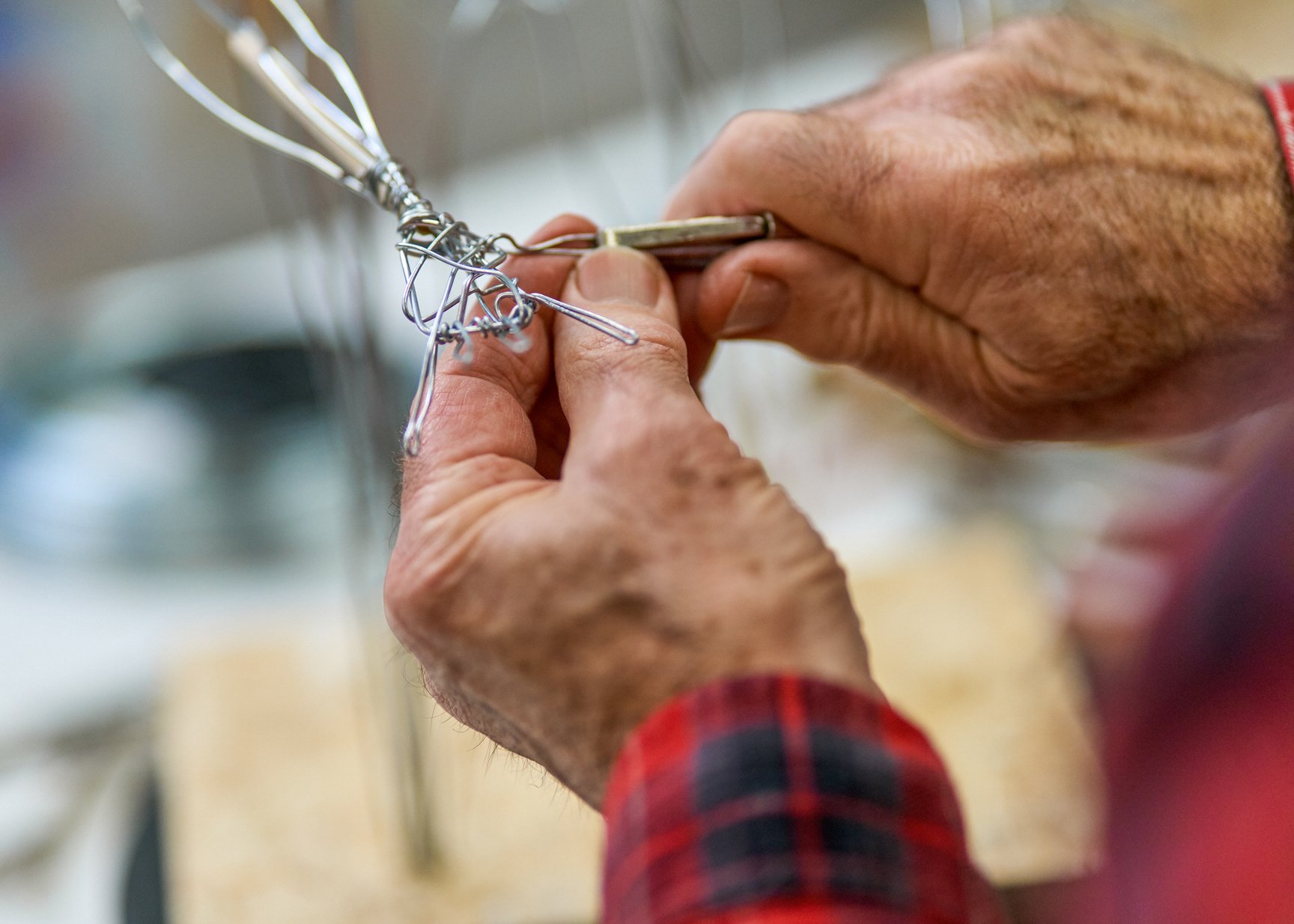
Hands are as important as the gesture of the figure for communicating with the viewer. The armature of twisted wire makes manipulation of each finger possible and makes the hands more expressive.
- Acrylic Painting
- This is an excellent medium for beginners. It dries quickly. Colors and shapes are easily corrected by adding another layer of paint. It is water-based and easy to clean up. Thinned pigments become transparent, like watercolor. Unlike oil paints, the consistency of acrylics will not cause surfaces to crack as paints cure.
- Archetype
- Archetype is a universal pattern, image, or character that recurs across art, culture, and human experience. Psychologist Carl Jung described archetypes as part of the collective unconscious—shared, inherited structures of meaning. In art, archetypal imagery often evokes similar emotional responses in both the artist and the viewer, regardless of background.
- Armature
- An armature is the internal or external structural framework of a sculpture or mask. It is typically made of twisted steel wire, rods, or other rigid materials that provide stability and support. In exoskeleton armatures, the wire functions like a line drawing in space, defining the planes and gesture of the sculpture as the surface is built up around it.
- Collective Unconscious
- The collective unconscious is Carl Jung’s term for the shared reservoir of universal human experiences and archetypal knowledge. These ideas are not individual possessions but part of a common human inheritance. In my work, I use physical symbols and archetypal forms to emphasize shared experience rather than divisions.
- Creative process
- Creativity is the act of problem solving. It is a unique or different response to a situation or condition that does not imitate an existing solution. It is not the same as imagination, which is a process of visualizing or problem creation.
- Illusion
- A facade or superficial appearance created when the mind mistakenly associates a pattern with an existing experience. The mind accepts the appearance as fact, masking the reality behind its own projection. In sculpture, form and space create illusions that may cause the viewer to reconsider their relationship to both.
- Imagination
- Imagination is the source of ideas not yet realized. It is the process of seeing something that may not yet exist. It is not bound by practicality or probability. It is not bound by anything. Patience may be the greatest asset for imagination. The longer you consider, the broader the realm of imagined possibilities. Imagination is the problem creator. Creativity is the problem solver.
- Masks
- Masks are among the oldest human objects. Nearly every culture has used them — ritual, theater, ceremony, transformation. What draws me to them is the same impulse that runs through all of my work: the desire to give form to something that exists beneath the surface of everyday experience. My masks are imaginative exaggerations of human qualities — the hidden, the shadowed, the parts of personality we rarely put on display. Large scale and physically present, they don't hang on a wall passively. They look back. That exchange between mask and viewer — direct, unmediated, and slightly unsettling — is what masks have always been for. Armatures for masks are usually a simple wire perimeter.
- Materials
- Each sculpture determines its own material requirements. I typically use steel wire armatures layered with polymer-infused fibers such as paper and fabric to create a rigid substrate. Additional polymer and thickener layers are applied—ranging from brushable coatings to thicker, clay-like textures. Sculptures are often mounted on a permanent base during this process, frequently carved marble. The final stage is painting, using polymer or acrylic mediums with acrylic pigments, both translucent and opaque, applying traditional painting principles to a three-dimensional surface.
- Mixed Media
- Mixed media refers to the use of multiple materials within a single artwork. In my practice, this usually includes several gauges of steel wire, organic fibers (wood, paper, fabric), and polymer mixtures to build surface texture and strength. In recent commissions, I have also used polymer combined with bronze powder, which can be polished to create a true bronze surface.
- Negative Space
- Negative space is the empty space surrounding and penetrating a sculpture’s form. In three-dimensional work, negative space is as important as the solid form, creating tension and inviting movement. Because the viewer physically occupies this space, they become an active part of the sculptural experience.
- Pattern
- Recognition is a process of matching what we see with what we know through experience. When we see something new, our brain matches it to the closest existing pattern. Archetypes are a form of pattern. We link knowledge or understanding to universal themes or characters in literature, art and behavior.
- Personal Mythology
- Personal mythology is the way an individual creates meaning from lived experience. Each person inhabits their own narrative—simultaneously director, actor, and audience—shaped by archetypes and circumstances. In creative work, this often involves imagining a problem and then creating its resolution. The accumulation of these responses and symbols forms one’s personal mythology.
- Plein Air Painting
- The phrase "en plein air" is a French description referring to painting outdoors. It is similar to "alla prima," the Italian phrase meaning at first attempt. A plein air painting is usually done outdoors and completed in a single session. It is direct observation expressed spontaneously to capture the moment. It can totally absorb the painter into a meditative state oblivious to any other surrounding activity. The freshness and honesty of this style of painting is usually different from studio paintings done over several sessions.
- Realization
- Realization is the act of bringing an imagined outcome into physical or social form. It may appear as a finished artwork, an interaction, or any manifestation first seen in the mind’s eye. Visualization and realization are closely connected; realization completes the imagined idea.
- Sculpture
- Sculpture within the scope of this site refers to the relationship between form and space. Positive shape surrounded by negative shape create dynamic views that invite viewers to move around the form and through the space to understand the whole.
- Spirit Painting
- First you learn to see, then to draw, then to paint. And then, you learn to paint what you feel. You draw out the essence of the subject and make marks that describe your response. When your soul communicates with the soul of your subject, you are painting its spirit. My spirit paintings are about my connection which is much deeper than physical. This is a form of documenting personal mythology.
- Symbolism
- Images or marks that represent ideas or communicate meaning beyond the literal. Symbols can represent functional concepts — as in an alphabet — or embody grander, universal meaning as in archetypes. In visual art, a symbol's power lies not in what it depicts but in what it activates in the viewer's own experience and memory.
- Unanswered Question
- Art that leaves questions unresolved invites deeper engagement. By presenting ambiguity rather than resolution, the viewer is encouraged to explore multiple interpretations. Painter/philosopher René Magritte used this strategy to create imagery that challenges logic and relies on the viewer’s personal experience for meaning.
- Visualization
- Visualization is anything perceived internally through the imagination. Sustained focus on an image creates tension between imagination and reality, often motivating action. When an idea becomes vivid enough, the subconscious creates realization in the physical world.
- Visual Communication
- Visual communication is the exchange of meaning through images and symbols. External visuals—such as letters, icons, or archetypal imagery — stimulate internal mental images and emotional responses. This ongoing visual “call and response” between image and viewer forms the foundation of communication.
- Watercolor Painting
- Watercolor is the original painting medium. Dirt and spit applied with the fingers onto cave walls about 40,000 years ago may be the first application. Powered ochres, charcoal and eventually pigments from organic material expanded the palette. Watercolor is considered one of the most difficult to master. It is, however, far more malleable than it appears. A combination of techniques, confident drawing, spontaneity, and flexibility are essential. It is a dance that requires the painter to make adjustments because the medium offers surprises. If you allow the pigments, water, paper and brush some freedom, the results are usually more pleasing than when you try to control the outcome.